


Say you followed a famous poet, a man known for his lyrical,
melancholy poems about place, down the backroads of Montana.
Would the towns you visit in his wake be his towns? Your towns?
Would your own history, the baggage you carry, shape your perceptions, just as his did?
Would your lasting impression be some gray, in-between thing with only a passing acquaintance with truth?
For years, Seattle writer Frances McCue followed the outsized footprints of Richard Hugo, Montana's most famous poet, as he wrote his way around the West.
Her journey is chronicled in a new book, "The Car That Brought You Here Still Runs."
More recently, in an effort to write about the book, we followed McCue's path around western Montana, a journey that left us two steps removed from the poet's truth.
People are also reading…
"I wanted to make the towns a little more real than he made them," McCue said recently. "I think for Hugo it wasn't important to be accurate in terms of those towns. He was being accurate to himself. He wanted to insist himself into these places and I think that he gave me permission to imagine myself in those towns. But they're not my towns or his towns. They're just what they are."
Starting in 1980, I came to know a handful of Montana towns under Hugo's influence. There seemed to be something omnipotent and right in his words, as if he'd been granted special access to the truth of places.
"One good restaurant and bars can't wipe the boredom out," he said in "Degrees of Gray in Philipsburg."
Wouldn't I feel the same if I lived there?
Perhaps, but I am easily amused.
After a few years of driving the state in Hugo's path, I started driving it on the newspaper's behalf. That's when I started talking to the townspeople whose lives Hugo mostly imagined.
And that's where our truths diverged. In much the same way, McCue found her own truth as she made her way around Hugo country.
"I want home full of grim permission.
You can go as out of business here
as rivers or the railroad station.
I knew it entering.
Five bourbons
and I'm in some other home."
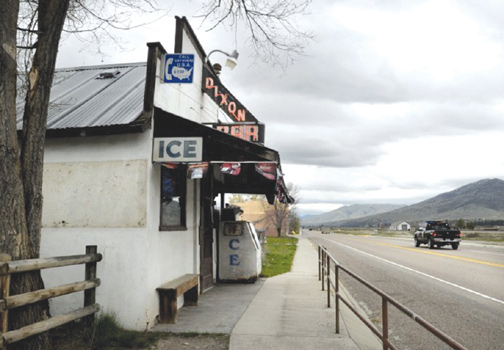
- Richard Hugo, "The Only Bar in Dixon."
Poetry rarely causes a ruckus outside the academy, but a trio of poems written by Hugo, Jim Welch and J.D. Reed kicked up a literary firestorm back in 1970.
After a day of fishing, the three writers stopped at the Dixon Bar on the way home, a not-uncommon practice on Hugo's fishing forays. After more than a few drinks, the fisherman-poets decided each would write a poem about the bar, then try to get them published together in one magazine.
Those poems, each titled "The Only Bar in Dixon," appeared in the New Yorker on Oct. 10, 1970.
Suffice it to say the poetry didn't go down as smoothly as the bourbon in Dixon.
"Poetry, laid out in free verse, wasn't the sport of rural places like Dixon, Montana," McCue wrote.
It likely wasn't the free verse that lit the fire. First, the bar's owner and
bartender, Joanne Schmauch, didn't swoon over a line in Welch's poem: "You can have the redheaded bartender for a word ..."
Of course, Schmauch was a redhead.
No one was much thrilled by Hugo's characterization of Dixon, either.
"This is home because some people
go to Perma and come back
from Perma saying Perma
is no fun ..."
Hardly a recommendation.
Schmauch wrote a letter to the Missoulian, castigating the poets and hinting that she and the mayor of Dixon were penning a poem of their own: "An Ode to Five-Bourbon Hugo."
Hugo then fired back with his own
letter to the editor.
"Joanne Schmauch finds my poems unflattering to Dixon but my poems are not about Dixon,"?Hugo wrote. "For Schmauch's edification, poems are works of imagination and are not intended to be factual accounts. ... If I wanted to write about Dixon, I'd write an article."
"It's a clever retort, clipped and pedantic at the same time," McCue wrote.
It also serves as a guidepost to the rest of the place poems, a hint to McCue and anyone else who fancies Hugo some sort of poetic tour guide.
"There are a number of things at work for him in the town poems, I think, and the towns are probably a small part of it," McCue said. "I think he'd come to town, sort of get a whiff of something in the air and run with it. From there, he was free to project his own sensibilities and the town just serves as a backdrop for his own narrative to play out."
Scholars of Hugo's work always note the impact of his hometown, White Center, Wash., and his upbringing on his work. White Center was and still is a rough-and-tumble suburb of Seattle, and Hugo's mother essentially abandoned him to the care of his grandparents, who came up short of loving and warm. His experience of both place and family left him a man who felt unworthy, a man looking for acceptance, "grim
permission" to come in from the
emotional cold.
So he walks into the only bar in Dixon and imagines himself a regular, a blue-collar guy, a guy from a town that has already seen its better days. Dixon is transformed, still Dixon, but also White Center, a son given up by a mother, a poet who wants to matter.
Which is all news to Dixon and a sweet canvas for McCue.
Her book is part look at Hugo's poetry, part travelogue, part voyage of personal and professional discovery.
"My desire, I realized, was a primal wish," she wrote. "I wanted to know where the poems began, where Hugo began, and by implication, where I began. What triggered the poem to become something from that town that wasn't of the town."
The town is never really the point of Hugo's work, but it's never really beside the point, either. In terms of place, the poems are both true and imagined. Paired with Hugo's sad imagery and dense rhythms, that liberation from the truth made a poetry that re-envisioned the West.
"I think he almost always put his
finger on some fundamental truth of the places he traveled to, but I don't think he felt burdened to get everything right," McCue said. "And that's fine to me. He's not really inhabiting the place so much as recreating the place he lives inside his head. The towns are a way to imagine both some other story line for a life, but it's his life, not the people who live there. I viewed my job basically as mapping a piece of writing back on to a place."
"On one hand, no matter what my salary is
or title, I remain a common laborer, stained by the perpetual
dust from loading flour or coal. I stay
humble, inadequate
inside. And my way of knowing how
people get hurt, make
my (damn this next word) heart go out through the stinking air
into the shacks of Walkerville, to the wife who has turned
forever to the wall, the husband sobbing at the kitchen
table, and the unwashed children taking it in and in and in
until they are the wall, the table, even the dog the parents
kill each month when the money's gone."
- Richard Hugo, "Letter to Levertov from Butte."
One thing about destinations - you often find whatever took you there.
Hugo didn't need Walkerville and Butte to feel dispossessed, outside, impoverished. But in a letter poem to Denise Levertov, a poet who moved in high society, he needed a base of operations. Walkerville, which sits atop Butte Hill and was home to the Alice and Lexington mines, was a perfect symbol for what Hugo wanted to say.
"In a Hugo poem, you are walking into the poorest part of town and, having a look, fearing that you might belong there," McCue wrote. "In a Levertov poem, you are observing the realm of the poem, and you feel unworthy of the scene, because the poet is placing the world above you. You are looking
heavenward as you read it."
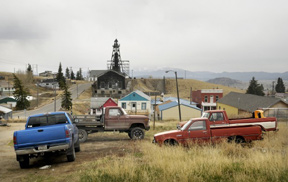
McCue resurrects Walkerville's history as the "spark held up to dry grasses." It's where mining got its start in Butte, and in its heyday was home to 4,000 people. Now about 700 live there, and they are, in general, along the lower end of the economic scale.
History is everywhere. Headframes of old mines jut from the earth. The inevitable engineering crew cleaning up the mess of the past rolls down the streets. The old Blaine School, now
converted to a church and a handful of curious office spaces. The alleys offer paths that end before arriving anywhere notable.
McCue, who views Hugo as a mentor despite the fact she never met him, is willing to question the poet's quickness to equate his history with those of Walkerville residents.
"Though Hugo claims he was a person coming from a place like this, I know he wasn't, not quite," McCue wrote. "White Center, though rough and downtrodden, didn't have the physical pollution of Walkerville - the land wasn't ripped open and burned in smelters."
That said, Hugo's place poems forge mostly psychological rather than geographical alliances with those he viewed as fellow outsiders.
Although Hugo's poem creates a town of children doomed to abuse, neglect and despair, Walkerville mostly has the problems every other town has, with an environmental disaster thrown in.
"This place has an amazing history, but that history has a residual effect that we'll be dealing with for years," said Dana St. John, a Butte native who now works as an engineer on mine-related cleanup projects.
And yet amidst the vestiges of the boom-bust cycle, life blossoms.
On a recent morning, the hood of a copper 1980 Buick opened to reveal a gray-haired woman checking a dipstick.
"I bought this car for $150 from the mayor," said Patricia Good. "Before that I took the bus."
Good came to Butte on a visit from Oklahoma about seven years ago.
"My ex-husband from 33 years ago called me up and told me he was up here and I should come up for a visit," she said. "So I did. And I just fell in love with Butte. I think it's just about the most beautiful place on earth. I especially love it in the snow."
Good, a member of the Cherokee Nation, is mostly retired, but she does Indian beadwork, makes elaborate chokers and stitches witty aphorisms onto sweatshirts, all of which she sells from a drab space in the former Blaine schoolhouse.
"Oh, you know, sometimes it sells and sometimes it doesn't," Good said. "Mostly it keeps me busy."
Good is amused that we've made a trip to Walkerville because of a poetry book, but notes that Butte is certainly verse-worthy.
"I sure do think you could write a poem about the most beautiful place on earth,"she said without a hint of irony.
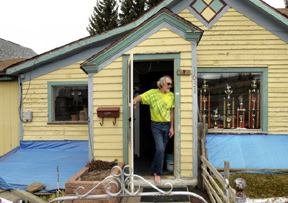
Up the hill, just across the street from the former location of the Alice mine's headframe, Ted Kerner stepped through the door of his aged, yellow home to talk. Part of the house, he said, used to be the hiring office for the Alice silver mine.
"This place is just alive with history, but you say some guy wrote a poem about Walkerville?" Kerner said. "He should have written about the mercury in my yard. But better than that would be writing about my son Frankie."
Kerner, wearing a tie-dyed green shirt, blue jeans and no shoes, broke into a rambling, loosely coherent monologue about his son's exploits as a skier and motorcyclist and made it clear, Richard Hugo be damned, the kids in his house are loved.
"That boy is a hell of a kid, all of ‘em are," he said as he led his visitors to a room that once held a still that supplied moonshine to miners. "Just look at all these trophies. I'm keeping 'em for one day when he's got a big ol' log house."
Kerner, who went to Blaine School as a boy, mined all over the West and still owns a claim in the Avon area.
"I'm gonna sell it soon," he said. "I'm done with mining. But I tell you what, this town will always be a mining town, even when it's not."
Outside, the wind blows dust bearing the remains of who-knows-what down the alley. Inside, a dad from Walkerville loves his children.
"Isn't this your life? That ancient kiss
still burning out your eyes. Isn't this defeat
so accurate, the church bell simply seems
a pure announcement: ring and no one comes?
Don't empty houses ring? Are magnesium
and scorn sufficient to support a town,
not just Philipsburg, but towns
of towering blondes, good jazz and booze
the world will never let you have until the town you came from dies inside?"
- Richard Hugo, "Degrees of Gray in Philipsburg."
Anyone who knows a Hugo poem knows this one. It's perhaps the purest distillation of what drove his place poems - the unworthy soul whose very unworthiness prevents admission to the good life.
"He'd traveled from the bottom of the culture heap to the top (if one considers low-paying professorships to be the top), though his self-image didn't make the journey quite as well as did his artistic production," McCue wrote.
McCue unleashes her full powers of dissection on both the poem and the town, parsing Hugo's motivations and intent and bearing witness to P-Burg's mining past and reinvention as a tourist town.
"I wonder, sometimes, if Hugo instigated his own competition for higher and higher stakes of martyrdom," McCue wrote. "It's a sad-sack Hugo, ‘the last good kiss' Hugo, who is part of the town that goes bust at
the same time he's looking at it like a sociologist might ..."
It's easy to read the death of Philipsburg into "Degrees of Gray," and it's possible the town was on life support when Hugo visited in 1966. But that's just another past today.
"I suppose it might have been sad for a while," said Joe Johnson, who bought the old George Washington School and is renovating it as a museum and antique store. "But I know you've been uptown. It's definitely not dead."
Hugo's degrees of gray are now replaced by bright, vibrant palettes that front gem shops, restaurants, a gym and a palace of sweets.
"There are a lot of folks looking to do business here, and we get a lot of people coming through," Johnson said.
Johnson has collected much of the town's past, from photographs to farming and mining equipment.
"This place is going to be high end when we're done with it," Johnson said. "This whole hall will be lined with pictures from Philipsburg."
Not surprisingly, Johnson had never heard of Hugo or the poem, though he agreed the town might serve as an inspiration for art.
"I don't know much about poetry, but from what I've seen it's mostly about the poet and not very much about the place," Johnson said.
McCue wouldn't disagree, at least not entirely.
"In the end, Hugo's ‘Degrees of Gray' is more about the visitor than it is about the town," she wrote.
Frances McCue covered many of the miles driven by Hugo in the Northwest. The book takes the reader around Hugo's home region of Puget Sound, meanders through the Silver Valley of Idaho and finally makes its way to Montana.
"I just felt so welcomed by people in Montana," she said. "I don't know that if you tried to do this book somewhere else it might not have worked the way it did."
She warmed in the response of Hugo's family and friends, many of whom she met when she and two other writers founded a writers' retreat in Seattle and named it after Hugo.
"They've been wonderfully open and supportive to the Hugo House and to me," McCue said. "They could have been proprietary and instead they were encouraging."
That openness made it much easier to hit the road when the idea of the book turned to reality.
"I think it would have been very hard without knowing they felt positive about it," she said.
Still, the book was a daunting undertaking.
"I didn't want to be a sociologist or a historian, but I did more of that than I imagined," she said. "I saw my expertise in reading the poems and being present for them and the places that inspired them. But it was bigger than that."
McCue imagined herself in far-flung places of the sort that are often described as "remote." But places are more similar than different anymore, she found.
"Even the faraway is not far away anymore," she wrote. "It's just a long drive."
So maybe Hugo was on to something when he stopped by for a few bourbons.
"Any morning
brings the same, a test of stamina,
your capacity to live the long day out
paced by the hesitant river. No chance
you might discover someone dead."
- Richard Hugo, "Dixon."
It's possible to see the truth in what Hugo said about the West without agreeing that everything he said is true.
"I think he was exceptional at earmarking what was interesting in a place," McCue said. "I don't think you take it as the literal truth or everyone's truth. It was his truth."
The West, of course, has always been both real and imaginary. Hugo knew that, knew that landscapes were both visible and internal.
"He played out a reinvented life in those towns," McCue said. "If you read them carefully, though, there's a truthfulness there that can't be avoided. He came pretty close to the bone."
Reporter Michael Moore may be reached at 523-5252 or by e-mail at mmoore@missoulian.com. Photography editor Kurt Wilson may be reached at 523-5244 or by e-mail at kwilson@missoulian.com.


